
Revenue Operations
How Faster Customer Response Times Drive Revenue Growth
Learn how response speed affects sales, retention and customer confidence, and how growing teams can improve it with a clearer communication workflow.
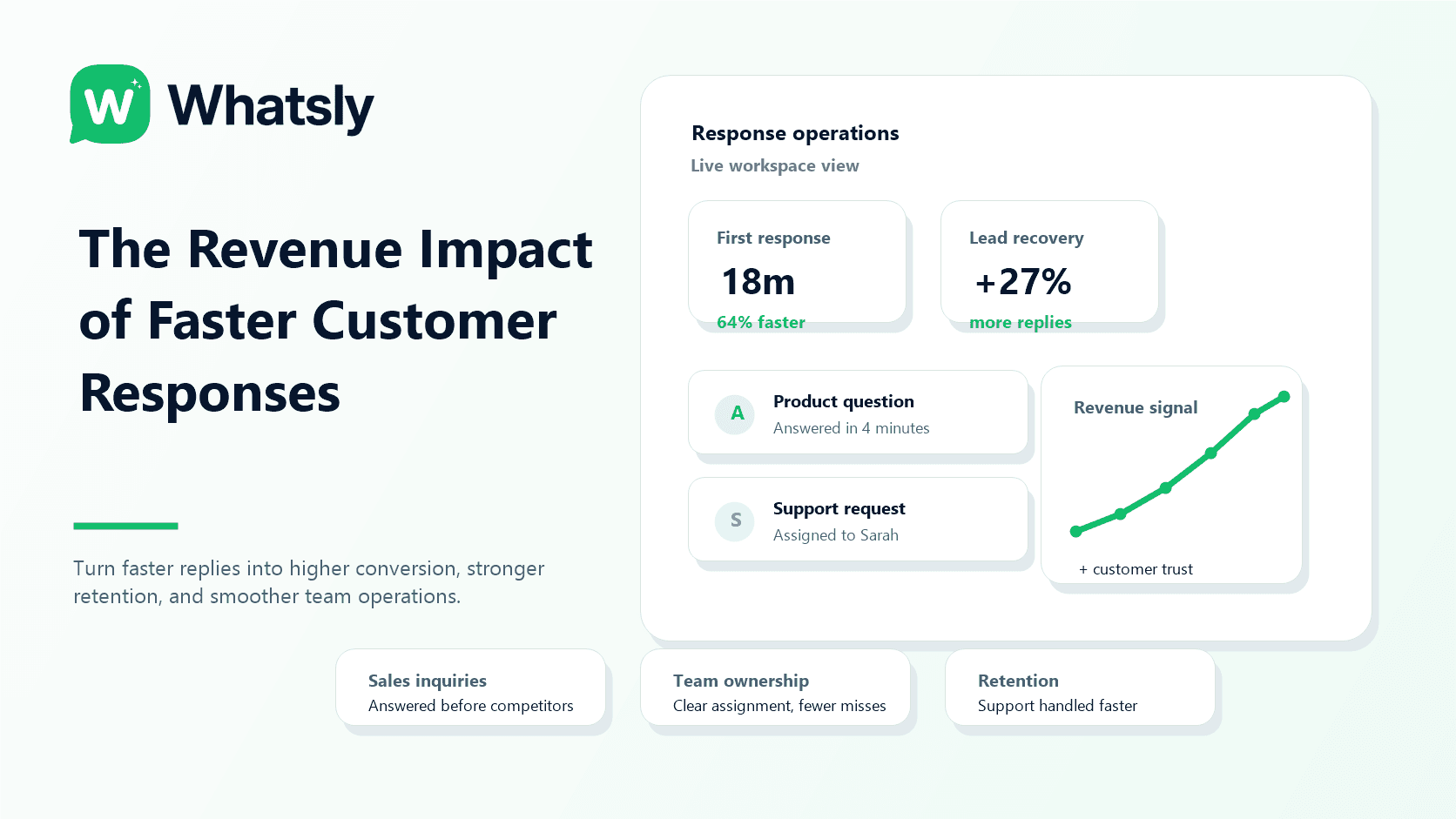
When businesses discuss growth, they often focus on marketing campaigns, new products or sales tactics. One of the most practical growth levers is easier to overlook: how quickly and clearly the business responds when a customer reaches out.
Every customer conversation represents an opportunity. A sales enquiry could become a new customer. A support question could protect an existing relationship. A complaint handled well could restore trust.
The challenge is that many businesses create delays unintentionally. Messages sit on one phone, ownership is unclear, context lives in another system, or a teammate assumes somebody else has replied.
Customer response speed is therefore more than a support metric. It is part of the buying experience.
Why response time matters more than ever
Customer expectations have changed. People are used to fast, direct communication when messaging friends, ordering food or checking a delivery. They bring similar expectations to business conversations.
When a business does not respond promptly, the customer may interpret the silence as:
- Lack of availability.
- Poor service.
- Low reliability.
- Limited interest in the enquiry.
- A sign that a competitor may be easier to deal with.
Those assumptions may be unfair, but they still influence decisions.
The hidden cost of slow responses
Delayed communication affects several parts of the customer relationship.
Lost sales opportunities
A customer might ask whether a product is in stock, whether an appointment is available or how quickly an order can arrive. If the answer comes hours later, the customer may already have chosen another business.
In competitive markets, response speed can influence the buying decision alongside price, availability and trust.
Lower customer retention
Existing customers expect efficient support. When questions remain unanswered, frustration grows. Repeated delays can make a customer less willing to renew, reorder or recommend the business.
Reduced team productivity
Slow replies are not always caused by too much work. They often come from an unclear workflow:
- Two people prepare the same response.
- Important messages are missed.
- Nobody knows who should act next.
- Customer context must be requested again.
- Staff switch between phones and business systems to find basic details.
The team spends time recovering information instead of helping the customer.
Common causes of slow response times
Conversations are managed individually
Many businesses begin with one employee and one WhatsApp phone. That can work at low volume, but it becomes fragile when more people need to sell, support or coordinate daily operations.
Customer context is hard to find
When history is limited to one device or spread across personal accounts, a teammate cannot quickly understand what the customer asked, what was promised or which files were already shared.
Responsibility is unclear
Messages often wait because every teammate can see them but nobody knows who is expected to respond. Even before advanced assignment tools are introduced, a documented ownership process can improve response speed.
Information lives in another system
Order, booking and payment details may sit in a commerce platform or internal tool. Without a focused connection, the operator must leave the conversation and search manually before replying.
Build a faster customer communication workflow
Improving response times requires an operational change, not simply more pressure on staff.
Create a clear response process
Define who reviews new enquiries, how urgent conversations are identified, when a question is escalated and what happens when the first person is unavailable.
Centralize customer conversations
A shared conversation history allows authorized teammates to see prior messages, understand the request and continue the conversation without asking the customer to start again.
Use consistent replies for repeated questions
Templates can reduce repetitive writing for common questions about pricing, opening hours, appointments, orders or delivery. The operator should still review and personalize the response before sending it.
Connect the information that matters
A focused WooCommerce, Shopify or API workflow can bring a useful order or booking event into the communication process. The goal is not to duplicate an entire business system. It is to make the next customer update easier and more accurate.
Prioritize high-value conversations
Teams should agree on which conversations need attention first, such as:
- New sales enquiries.
- Time-sensitive order or booking questions.
- Support escalations.
- Payment issues.
- Customers waiting for a promised follow-up.
An illustrative operating scenario
Consider two businesses receiving a similar number of customer enquiries.
Business A relies on one phone, personal memory and manual forwarding. Business B gives authorized teammates a shared conversation history, a clear response process and access to the information needed for common questions.
Business B is more likely to:
- Respond before the customer moves elsewhere.
- Preserve context when another teammate takes over.
- Avoid duplicate or contradictory replies.
- Follow up consistently.
- identify recurring questions that can be handled more efficiently.
The difference is not necessarily team size. It is the communication workflow.
Measure what matters
Start with a small set of practical measures.
First response time
How long does it take the team to acknowledge a new customer enquiry?
Resolution time
How long does it take to provide the complete answer or finish the requested action?
Waiting conversations
How many customer conversations still need a reply or follow-up?
Quality of the response
Did the operator understand the question, use the available context and explain the next step clearly?
Workload distribution
Are conversations repeatedly waiting for one person, or can the authorized team continue the work?
Metrics should help the team find operational friction. They should not encourage empty replies that improve a number without helping the customer.
Response time as a growth strategy
Customer communication influences:
- Lead conversion.
- Customer retention.
- Brand reputation.
- Team efficiency.
- Repeat purchases.
- Customer lifetime value.
Businesses that treat response operations as part of the customer journey can improve both service and commercial outcomes.
Conclusion
Faster responses create better customer experiences when they are supported by clear ownership, useful context and a practical next step.
Whatsly helps businesses bring customer conversations and connected workflows into one shared workspace. Teams can search conversation history, use consistent responses and keep relevant order or system events close to the customer interaction.
Small improvements in how the team receives, understands and answers customer messages can produce meaningful improvements in trust, conversion and retention.